

Understand closure liabilities and their effect on value and funding.




Understand the exposure. Test the estimate.
Closure Readiness and Liability Assessment
- Closure obligations and evidence map
- Cost, provision and security reconciliation
- Readiness gaps and closure risk register
- Decision memo and priority action plan
Independent Closure Cost and Liability Review
- Findings report and priority actions
- Supported cost adjustments or ranges
- Cost and timing scenario results
- Value and financial assurance implications
How closure evidence informs your decision.



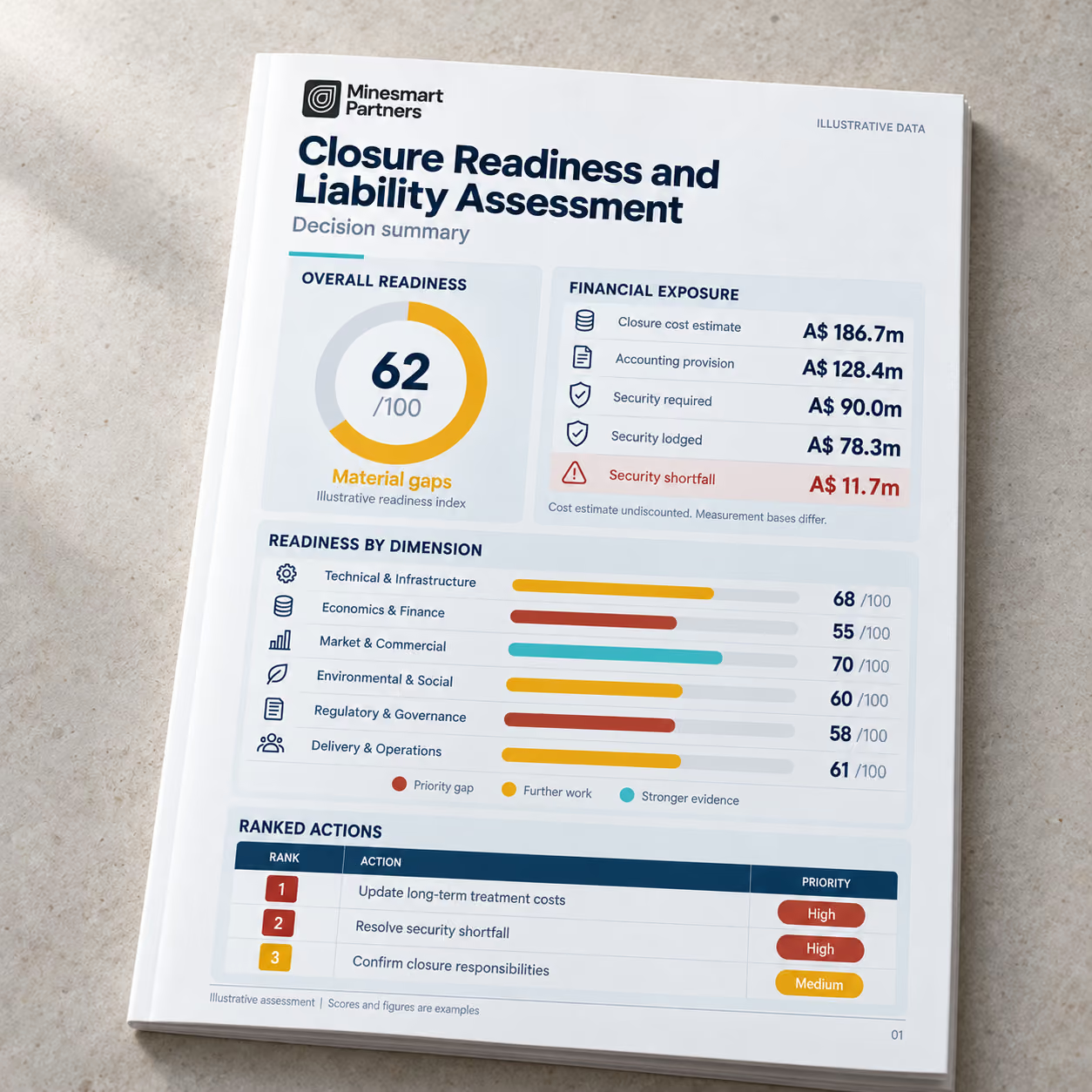
Independent Closure Cost and Liability Review

Closure costs, provisions and security.



Evidence behind the assessment.

We review existing closure plans, documented permit conditions, rehabilitation commitments and stakeholder agreements. We check whether the proposed work, completion criteria and assigned responsibilities are reflected consistently in the supporting evidence.This helps identify obligations missing from the estimate, unresolved commitments and assumptions requiring specialist review. Material gaps are translated into actions and potential cost, timing or funding exposure.
We examine the estimate’s scope, quantities, unit rates, exclusions, contingency and escalation assumptions, drawing on qualified closure specialists for technical judgements. We check the estimate’s date, supporting studies and treatment of rehabilitation, demolition, monitoring and long-term care.This establishes which costs are supported, where adjustments or ranges are justified, and which uncertainties could materially affect the decision.
We examine the closure schedule, progressive rehabilitation, care and maintenance assumptions, and the expected duration of monitoring and treatment. Where the evidence supports it, we test alternative timing, sudden closure and longer post-closure obligations.This shows when expenditure could arise, how long it may continue and how different scenarios affect cash flow, asset value and funding needs.
We review the documented basis of accounting provisions alongside closure estimates, security requirements and existing assurance arrangements. We examine differences in scope, timing and measurement, together with instrument terms, collateral requirements and review or release conditions.This explains why the amounts differ and where security commitments could constrain liquidity or credit capacity, while keeping accounting liabilities, closure expenditure and financial assurance distinct.
Questions clients ask before engaging
Our core services assess closure readiness, review existing estimates and explain the economic implications. Qualified closure specialists support technical judgements and retain responsibility for their opinions. Detailed closure-plan preparation, engineering design, site verification and implementation require separate appointments. We identify where that work is needed and use the resulting evidence in our analysis.
Choose the Closure Readiness and Liability Assessment to understand the available evidence, reconcile costs, provisions and security, and identify priority gaps. Choose the Independent Closure Cost and Liability Review when you need a specified estimate challenged in greater depth. Either can be commissioned directly. Any follow-on work is scoped separately around a defined need.
We examine whether its scope, assumptions and timing support the decision you face. With a qualified closure specialist, we challenge material inputs, identify supported adjustments and test relevant scenarios. We then explain the consequences for value, cash flow and funding. Findings may support the existing estimate or identify changes and further evidence needed.
We typically start with the current closure plan, cost model, schedule, documented obligations, supporting studies, accounting provision and financial assurance arrangements. A readiness assessment can identify gaps in incomplete evidence. A detailed cost review requires enough support to challenge the estimate meaningfully. We distinguish supported conclusions from uncertainties requiring further specialist work.
Before accepting a review, we assess prior involvement, financial interests and relevant client relationships. We do not present a review of our own work as independent. Our fees are agreed for the work and are not contingent on a transaction completing or a particular finding. Material conflicts determine whether we can accept the appointment and in what capacity.
Yes. We can scope closure analysis for transaction due diligence, lending decisions or a regulator’s review of an operator’s estimate. We agree the intended users, decision deadline and reliance requirements before starting. The work identifies material exposure and unresolved issues; formal submissions, certifications and professional opinions require the appropriate specialists and separate scope.
We start with your decision, the asset and the evidence available. Our proposal defines the deliverables, depth of review, scenarios, specialist input, responsibilities and intended use of the report. Timing and fees reflect those requirements and any information gaps. Additional assets, revised estimates or further analysis are agreed separately before the scope expands.
