Insights

Why Single-Number Financial Models Cost Mining Projects Their Financing

Every lender stress-tests your numbers against their own assumptions. Here is why financial models that capture the full range of outcomes, not just the base case, change the investment conversation and what lenders actually trust.
June 1, 2026

Every mining project financial model has a base case. A single set of assumptions producing a single NPV, a single IRR, and a single set of cash flows across the life of mine. The developer presents this number to a lender. The lender rebuilds the model to their own assumptions and produces a different number. The gap between those two numbers determines whether a mandate is issued and on what terms.

This process is entirely predictable, entirely avoidable, and almost universally experienced by developers who have not been through a project financing before.

The problem is not that the developer's model is wrong. In most cases it is technically competent and internally consistent. The problem is that it is built to answer the wrong question. A base-case financial model answers: what are the expected returns on this project under our assumptions? A lender is asking: what is the realistic range of outcomes on this project, and what is the probability that it services its debt under adverse conditions?

These are not the same question. And a single-number model cannot answer the second one.

How Lenders Actually Stress-Test a Financial Model

When a project finance bank receives a developer's financial model, the credit team does not accept the base case as the starting point for analysis. They rebuild it. They apply five standard adjustments that are applied consistently across every mining project finance transaction, regardless of commodity, jurisdiction, or project scale.

Reserves are restricted to Proved and Probable only, removing Inferred and Measured-and-Indicated resources from the life of mine plan. The commodity price deck is set at 70 to 85 percent of long-run consensus, below the developer's typically more optimistic assumption. Operating costs receive a five to ten percent buffer above the BFS estimate. Capital costs are set with 15 to 20 percent contingency. The production ramp-up is extended by six to twelve months beyond the developer's schedule.

Each of these adjustments is applied individually, and then all five are applied simultaneously to produce a combined stress case. The credit committee then asks: under this combined stress, does the project maintain a Debt Service Coverage Ratio above 1.20 to 1.30 times throughout the life of the debt? If the answer is no, the project does not meet the bank's credit criteria in its current form.

A developer who has not pre-modelled this scenario does not know where their project stands until the bank tells them. By that point, the mandate approach has already been made and the developer is responding to the bank's findings rather than presenting their own analysis.

The Sensitivity Analysis Problem

Most financial models include a sensitivity analysis. It shows the impact on NPV or IRR of changing one variable at a time — commodity price by ten percent, operating cost by ten percent, capital cost by ten percent — while holding all other inputs constant.

This is a useful tool for understanding which inputs matter most to the project economics. It is not a useful tool for understanding what happens to the project when adverse conditions occur simultaneously, which is exactly how adverse conditions occur in practice.

Grade disappointment, cost overruns, and commodity price weakness do not happen in isolation. They happen together. A sensitivity analysis cannot capture that. A Monte Carlo simulation does.

When a copper project experiences lower-than-expected head grades, it also typically experiences higher-than-expected processing costs per tonne of metal produced, higher-than-expected reagent consumption, and often a commodity price environment that contributed to the investment decision being made at a moment of optimism. These conditions are correlated. A sensitivity analysis that moves each input independently understates the combined impact of a realistic downside scenario by a significant margin.

This is not a theoretical concern. It is the documented experience of the majority of mining projects that have reached construction. McKinsey's 2024 analysis of 80 global mining projects found that megaprojects averaging more than USD 1 billion in capital expenditure suffered average cost overruns of 79 percent and schedule delays of 52 percent. Projects that experienced cost overruns almost universally also experienced schedule delays and commodity price movements that compounded the financial impact. The individual sensitivity movements were known. The combined impact was not modelled.

What Stochastic Simulation Produces

A stochastic simulation model starts from a different place than a deterministic financial model. Rather than assigning a single value to each input, it assigns each input a calibrated range reflecting the realistic spread of outcomes observed in comparable projects. Rather than running one scenario, it runs thousands of scenarios simultaneously, varying every input across its full range at the same time.

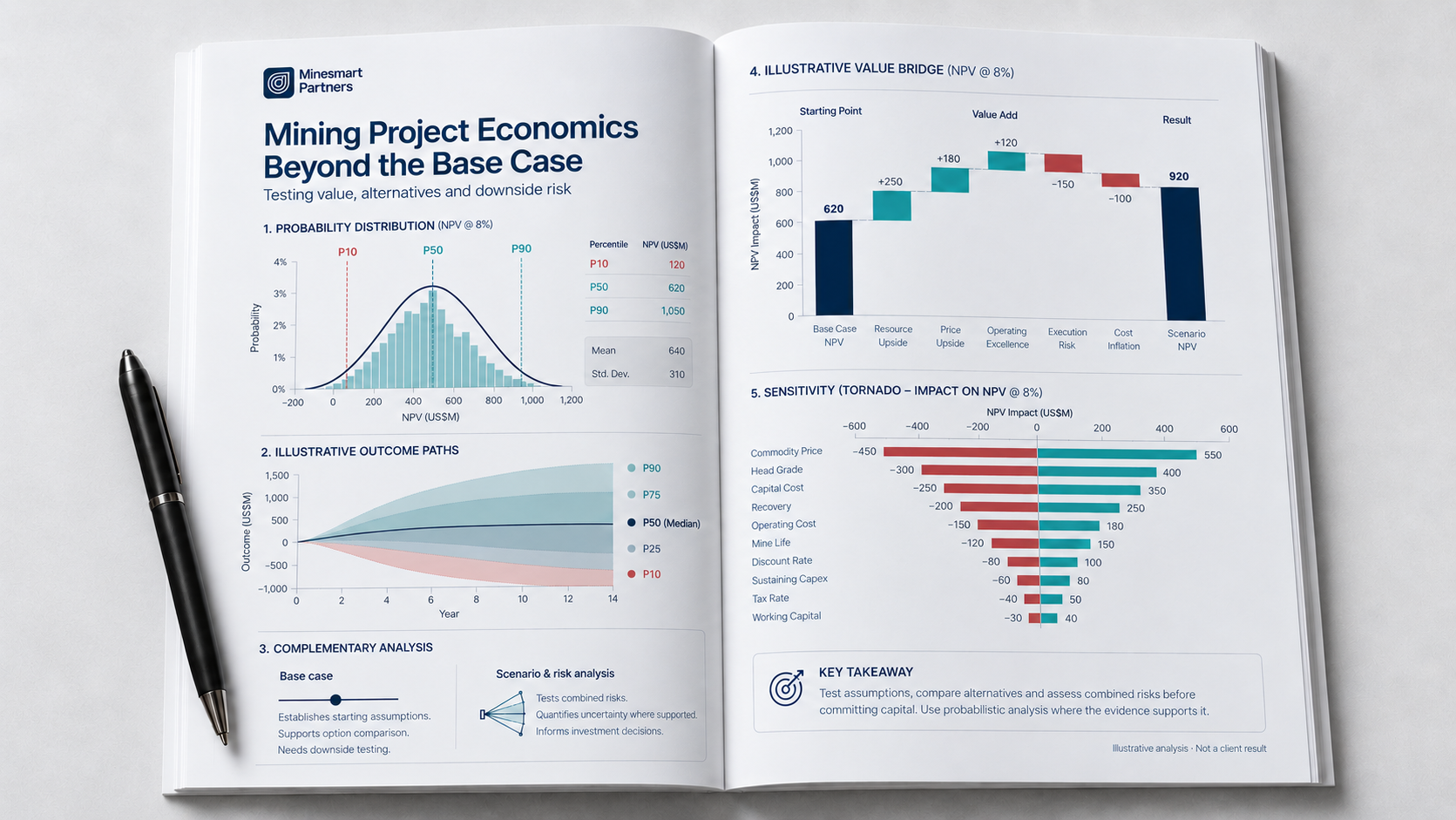
The result is not a single number. It is a complete probability distribution of outcomes. The P90 downside case shows what happens when conditions are adverse across the board. The P50 base case shows the most likely outcome. The P10 upside case shows what the project looks like under favourable conditions. And crucially, the model shows the probability that the project maintains its DSCR above the lender's covenant floor under any given scenario.

  • P90 downside. The outcome the project produces or exceeds in 90 percent of scenarios. The lender's primary reference point for credit analysis.
  • P50 base case.  The most likely outcome across all scenarios. The central estimate the developer and lender use as the reference for base-case debt structuring.
  • P10 upside.  The outcome the project produces or exceeds in only ten percent of scenarios. Useful for equity return analysis and upside case structuring.

When a developer presents a model that already incorporates P10, P50, and P90 outcomes calibrated to empirical data from comparable projects, the lender's credit team is not rebuilding the model. They are verifying it. The conversation shifts from discovery — what does this project actually look like under stress — to confirmation — does our view of the downside align with yours.

That is a materially different conversation. And it is a materially shorter one.

The Value Driver Insight

A stochastic simulation model produces a second output that a deterministic model cannot: a value driver ranking. By running thousands of scenarios and observing which input variations have the largest impact on the distribution of outcomes, the model identifies which technical and financial assumptions carry the most weight in the project economics.

In most mining projects, three to five inputs account for the majority of the uncertainty in NPV and DSCR outcomes. Commodity price, head grade, and capital cost are almost always in the top five. Metallurgical recovery, ramp-up schedule, and operating cost are frequently material. The ranking is project-specific and stage-specific, and it changes as the project develops and technical uncertainty is progressively reduced.

Knowing which inputs drive the most uncertainty tells a developer exactly where to focus their risk mitigation effort. It also tells a lender which assumptions deserve the most scrutiny. Presenting this analysis proactively is a signal that the developer understands their own project more deeply than most.

A developer who can present a ranked value driver analysis alongside their financial model is showing a lender that they have not just modelled the project but understood it. They know which assumptions are critical. They know where the model is most sensitive. And they have quantified the financial consequence of uncertainty in each of those assumptions rather than presenting a single number and hoping the lender accepts it.

What Changes When the Model Is Built This Way

A financial model built to stochastic standards, with every input independently validated against empirical benchmarks from comparable projects and every output expressed as a probability distribution, changes three things about the financing conversation.

First, it eliminates the gap between the developer's model and the bank's model. When the developer has already applied bank conventions, calibrated inputs to conservative benchmarks, and presented P10, P50, and P90 outcomes, there is nothing left for the bank to rebuild. The credit team is verifying assumptions rather than replacing them.

Second, it answers the credit committee's primary question directly. What is the probability that this project services its debt under adverse conditions? A stochastic model answers this with a specific number, not a qualitative statement.

Third, it signals a level of analytical rigour that is immediately apparent to any lender who has reviewed hundreds of mining project models. Most models they receive are deterministic, built to developer assumptions, and presented without a value driver analysis. A stochastic model built to bank conventions with calibrated empirical inputs is immediately distinguishable. It reads as the work of a team that understands what a lender needs, rather than a team that is hoping the lender will accept what they have produced.

The financing conversation in mining is ultimately a conversation about uncertainty. Every party at the table is making a decision under conditions that cannot be known with certainty. The question is whether the uncertainty has been quantified and managed, or whether it is being obscured behind a single base-case number that will be rebuilt before the first substantive discussion begins.

A model that shows the full range of outcomes does not make a project look riskier. It makes the developer look more credible. And credibility, in a project finance credit process, is the most important input of all.

About Minesmart Partners

Minesmart Partners is a specialist mining and critical minerals advisory firm providing Investment Readiness Assessments, Techno-Economic Modelling, and Integrated Risk Assessments for mining projects at every stage of development. We occupy the integration layer between technical consultants, ESG specialists, and financial advisors, producing the single decision-ready investment case that credit committees, DFI investment officers, and equity fund ICs actually need.

Get Started

Ready to buildyour investment case?

Tell us about your project and we’ll show you the path forward.
Schedule a Strategy Call
Need help?